Thursday, December 12, 2013

Parallels between Guillermo Del Toro's Pan's Labyrinth and The Grimm Brothers' Little Red Cap


Initial Observations:

Guillermo Del Toro’s Pan’s Labyrinth is a composite of many different classic fairy tales. There are traces Hansel and Gretel when Ofelia faces the pale man, and the film even has the evil stepmother trope but in the film it’s an evil stepfather. Yet, one fairy tale that seems to outline the film is The Grimm Brothers’ The Little Red Cap.  The film follows a little girl, Ofelia dealing with the death of her father and her mother remarrying the extremely violent Captain Vidal. When the film begins, Ofelia’s mother, Carmen is pregnant with Captain Vidal’s baby.

On the way  to moving in with Captain Vidal Ofelia triggers the event that would lead the Faun revealing that Ofelia was at one point a princess and needs to complete three tasks to reclaim the title. While completing the three tasks, Ofelia’s mother becomes deathly ill and the Faun uses this to manipulate her to into completing the final two tasks. While her mother is ill, Ofelia becomes close to a woman named Mercedes who works for Captain Vidal. To help her mother, Ofelia, has to complete the tasks that were meant to prove she was the princess the faun had led her to believe. Carmen eventually dies, Mercedes gets captured by Vidal, and Ofelia has to complete the last task.

We see there is a vague similarity between The Little Red Cap and Pan’s Labyrinth throughout the film. In the beginning, she is wondering the forest alone which leads her to unleash the events that take place throughout the film. Additionally, to get back to her real family she has to go through the forest to take her baby brother through the labyrinth. Were we see, her lost in the labyrinth until it opens itself to her. Ofelia’s goal throughout the film is either to help her mother get better or to return to the family the Faun says she is really a part of.

Much like little red is trying to get to her grandmother to help nurse back to health. Yet, the wrinkle in her plan is the big bad wolf, or in Ofelia’s case Captain Vidal. Captain Vidal is of course an oppressive force that seeks to control everything in his path. His hateful and oppressive nature is almost a supernatural force.  We see him survive multiple attempts on his life much like the big bad wolf survived multiple attempts on its life. That were made by the hunter, or Mercedes, and it wasn’t until both experienced an extremely violent death did they both cease to exist. The central location of the film takes place in a country home that looks like a cabin much like the little red’s story ultimately takes place. 

Historical Background:

In the original, French version, of Little Red Riding Hood, little red is killed by the wolf she is not saved in the final moments like in the Grimm version.  Many have suggested that this version the story is about chastity and seduction and a warning against being seduced by suitors who didn’t have their best interests in mind. Furthermore in French, there is slang for when a woman loses her virginity which is elle avoit vû le loup meaning “she’d seen the wolf,” so we can infer the effect this fairy tale has had over time. Additionally, red was a symbol for scandal and blood which sentenced Little Red from the very beginning.

 In the Grimm version of the tale introduces the lumberjack saves Little Red from the wolf. The lumberjack character can be seen as a protector, a counselor, and maybe even a father figure. Making these few changed the meaning of the fairy tale from one of chastity to one of the importance of obeying the rules set out as safety measures.  Ofelia doesn’t follow the rules, she ate the food on the pale man’s table, while she was in the base of the tree she looked back when she was told not to, and she did not hand over her brother to the Faun. Yet in the end, Mercedes kills Vidal saving her brother and Ofelia is depending on your interpreting of the film she is either dead or the princess.  Unlike the moral of the Grimm brothers’ version and no matter your interpretation of the film, Del Toro is saying that sometimes it is the best thing not to follow the rules.  Mercedes and the rebels broke the rules to escape oppression. Ofelia failed to follow rules set forth by the Faun and as a result she died but was immortalized if you choose to believe as the princess.


Another, connection between the early version of the Little Red Riding Hood story and Pan’s Labyrinth is the scene where Ofelia goes to see what her second task is but the pages of the book only reveal the pages covered in red. We then see Ofelia’s mother covered in her own blood and we can tell something is wrong with the baby. Like previously stated she dies, much like Little Red she was cloaked in red and fated to die with no redemption. 

Music Connection :

The music played throughout the film is a kind of dark lullaby with a melancholic tone. This matches the feeling of them film and the tone is so soft that it blends into the background of the film, going unnoticed. The music is unlike the kind of music that is heard in another film we watched this semester, Tsotsi, it isn’t loud or intrusive, but like the music featured in Tsotsi it tells the audience how to react and feel during the film. As for an example, when the film begins the music sounds like a dream, sweet, and light. Although the fist images of the film are of the death of Ofelia we still feel as though the music it self is saying "once upon a time, in  a place long time ago." Yet, as the tone of the film becomes darker so does the tone of the music that accompanies the film.

Visual Connection:

A lot of the film looks hand drawn, particularly the fairy tale elements giving it an actual fairy tale feel. Like the detail on the Faun specifically the lines on his head and arms, and we also see it in the pale man’s lair except they were illustrations of it eating small children. The fairies also look hand drawn and the fact that they mirrored their appearance from the fairies out of Ofelia’s book reinforces the fairy tale theme. On the other hand, the natural elements seen in the film look inoffensive but many are the gateway to the supernatural world or allow Ofelia to go to the other side. So they tend to be big or menacing in some way like the tree from the first task or the thorn vines in the labyrinth from the final task.  Like many fairy tales authors, Del Toro created this world that is magical yet dangerous and wondrous yet terrifying. 


How Del Toro Uses Little Red Cap:

Both stories deal with the consequences of breaking the rules, yet with the choices made by Del Toro the film tells the audience that sometimes it is necessary to break the rules.  The moral of the Little Red Cap is obedience and listening to your elders.  Yet, Captain Vidal, who lived his life by the ticking of his pocket watch, and Carmen who followed rules to survive both met their end in Del Toro’s film. While Ofelia and Mercedes who choose not to follow the rules or failed to did something good and they both changed the world around them for the better.  Moreover, fairy tales were a way to pass on lessons to children, and like I previously mentioned the Grimm’s version is one about obedience. Yet if Mercedes, the rebels, and Ofelia took their situation as it was than the people of Spain would have continued to live under oppression, Ofelia’s brother would have been raised in the same manner as Captain Vidal. Also depending on how you look at the end Ofelia would not have gone home to her real family and there is no telling what Vidal would have done with her.  Like the old saying goes some rules are just made to be broken, or rather when faced with such oppression, something that seems so impossible, the only thing to do is break the rule and stand up for yourself and others. 

Source: Orenstein, Catherine "Dances With Wolves: Little Red Ridding Hoods Long Walk in The Woods." Ms. Magazine,  n.p.  summer 2004.  22,  December 2013 

Wednesday, November 20, 2013

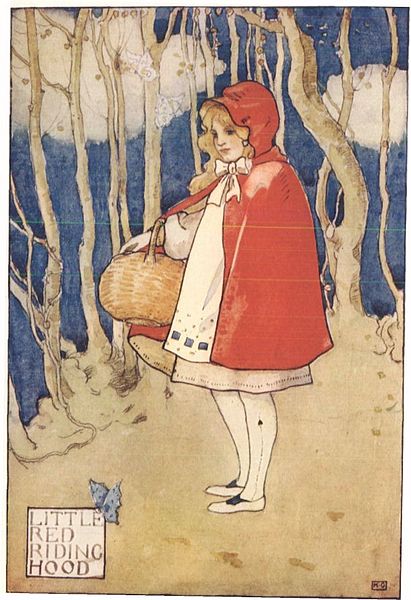
The Grimm Brothers' Version of Little Red Riding Hood and Pan's labyrinth


The story revolves around a girl called Little Red Riding Hood, after the red hooded cape/cloak (in Perrault's fairytale) or simple cap (in the Grimms' version called Little Red-Cap) she wears. The girl walks through the woods to deliver food to her sickly grandmother (grape juice and banana bread, or wine and cake depending on the translation). In the Grimms' version at least, she had the order from her mother to stay strictly on the path.


A mean wolf wants to eat the girl and the food in the basket. He secretly stalks her behind trees and bushes and shrubs and patches of little grass and patches of tall grass. He approaches Little Red Riding Hood and she naïvely tells him where she is going. He suggests the girl pick some flowers, which she does. In the meantime, he goes to the grandmother's house and gains entry by pretending to be the girl. He swallows the grandmother whole (in some stories, he locks her in the closet) and waits for the girl, disguised as the grandma.


When the girl arrives, she notices that her grandmother looks very strange. Little Red then says, "What a deep voice you have!" ("The better to greet you with"), "Goodness, what big eyes you have!" ("The better to see you with"), "And what big hands you have!" ("The better to hug/grab you with"), and lastly, "What a big mouth you have" ("The better to eat you with!"), at which point the wolf jumps out of bed, and swallows her up too. Then he falls asleep.


A lumberjack (with the Brothers Grimm, and always in German tradition, a hunter), however, comes to the rescue and with his axe cuts open the wolf, who had fallen asleep. Little Red Riding Hood and her grandmother emerge unharmed. They fill the wolf's body with heavy stones. The wolf awakens and tries to flee, but the stones cause him to collapse and die. (Sanitized versions of the story have the grandmother shut in the closet instead of eaten, and some have Little Red Riding Hood saved by the lumberjack as the wolf advances on her, rather than after she is eaten.)[4]


  • Carmen (her mother)-The Grandmother
  • Mercedes-Hunter/Lumberjack
  • Captain Vidal-The big bad wolf
  • Ofelia-Little Red 


Friday, November 15, 2013

Response to Water

The film follows Chuyia, one of the many widows of India as she tries to figure out what it means to be a widow. As a young child she was already married off to older man who by the time the film begins is dying. Not a moment was wasted before her head was shaved, was given a white Sari and sent to live with other widows. She constantly questions the laws set out for the widows of India and has trouble conforming to them. Especially why widows have to live a life of purity and perpetual mourning for the husband they have lost.


Chuyia believes that her stay with the widows is only temporary so she acts like it is.  More importantly, she acts her age when it comes to handling situations that beyond her control.  She runs, screams, fights, and hurts people who hurt her. Shakuntala who follows every law of the widow and seeks religious counseling often becomes a maternal figure for Chuyia.  Everything Shakuntala did was to fulfill her obligation to her religion until she heard the laws where changing. She then knew that Chuiya’s life could be better so decides to give her to Narayan to make sure Chuyia gets to Gandhi, someone promised to change things for widows in India. 

Saturday, November 2, 2013

Interesting use of music in Nicolas Winding Refn's Drive


What makes this use of music so amazing is  in this scene is how "Under Your Spell" by Desire can be heard first as a diegetic sound coming through the walls while we are in Driver's apartment. Then we hear it full blast in Irene's apartment again as a diegetic sound until her husband Standard mentions how much he appreciates how she stood by him while he was in jail. Yet during this time Irene met and fell in love with Driver and you see that expressed with the close up on Driver and Irene  in their apartments respectively  while "Under My Spell" is clearly non-diegetic. The song then goes back to a diegetic song when Driver is leaving his apartment. I just think it is absolutely brilliant the way the Winding Refn used this song how two characters who rarely speak feel about each as well as using it in a way that is clever and feels grounded in reality.

Wednesday, October 30, 2013

Response to the film Tsotsi

According to the Tsotsi film website the music that is used in the film is called Kwaito and it is “the modern music of South African townships” and it is used in the film“to add the authentic feel of ghetto street life.”  Further look in to what the word Kwaito, the South African Concise Oxford Dictionary says that the word comes from the name “Amakwaito” which was a group of 1950’s gangsters in a Johannesburg township. Who took their name from the Afrikaans word “kwaai” which means “angry” or “vicious.” The style of Kwaito is home-grown dance music that is like spoken word set to an instrumental background. This genre of music started to appear in South Africa in the 1990’s. Kwaito is a mixture of many different sounds, namely marabi sounds of the 1920’s, kwela of the 1950’s, mbaqanga/maskhandi of the hostel dwellers, pop music of the 1980’s, and African praise poetry (Imibongo).

            That being said what Tsotsi does very well is setup and maintain the mood of the film with the music. The first song we hear is “Mdlwembe” this song has the feeling of western rap song. “Mdlwembe” plus the sequence of Tsotsi walking down the flight of stairs while getting yelled at. Really sets up the character of Tsotsi as someone who is a strong force in this particular township. As Tsotsi changes as a character so does the music, the more he has to care for that child the more he goes through a transformation. He grows attached to the baby because this he has been deprived of affection all his life so he feels the need to be a father to this child even though it isn’t healthy or reasonable. The moment when Tsotsi experiences a dramatic change is when he awakes the next day and is faced with taking care of the child’s needs. “Mnt’ Omnyama” is far more upbeat then any of the previous songs and is almost out of place during this scene. The way he was trying to take care of the child even though he wasn’t well equipped was startling and to have an upbeat song in the background made the scene even more unsettling.


            The final few songs featured in the film are somber and sad but more importantly it reinforces the fact that he no longer is the violent man he was before. These songs show the audience that he has shifted his focus beyond criminal activity and beyond the care of the child.  The final song, “E Sale Noka” is a warm and light and fits the theory of Tsotsi finally feeling redeemed at the end of the film. 
            An interesting side note most of the music is performed by Zola who played Fela (The head of the rival gang) in the film. His real name is Bonginkosi Dlamini he grew up in Soweto in the township called Zola which is where he took his name. Zola is an actor, poet, and musician and has arisen as a big name of Kwaito.

 More information on the film Tsotsi http://www.tsotsi.com/english/index.php (my source)


Saturday, October 19, 2013

Interesting special effects from Edgar Wright's Scott Pilgrim vs. The World


The whole movie is filled with beautiful eye catching special effects that really make this movie unique. 

Friday, October 18, 2013

My response to the movie The Whale Rider


In The Whale Rider, we experience a changing community that no longer follows the traditions of their culture at the same rate they once practiced. We see a generation disinterested in taking on the responsibilities of adulthood. Furthermore, we see parents abandoning their duties to go off and to satisfy their own needs.  We see kids rebelling in many different ways and especially with Paikea when she goes against her grandfather’s wishes when she teaches herself how to be a leader.


Paikea rebels in the first place because Koro her grandfather who was always focused on the traditions and the “chosen” first born son.  When finds out that his grandson died during child birth he becomes upset because there isn’t a first born son to take over he even resents Paikea for living in away.  He blames her for the way their community has fallen apart, so later on he takes all of the first born sons to train them to be leaders. Believing this will be the salvation of his community and he believes this because this is something that he has been taught from birth.

As a result of Koro’s need to repair his community the only way he knows how he excludes Paikea and almost viciously so. So she teaches herself to be a leader and a warrior and is somehow connected to these whales that when she calls on for help the whales beach themselves and are in danger of dying. Paikea helps them by giving them the strength to go on like the Paikea of her namesake was given strength by the whales so long ago to keep on going and to survive.  After this occurrence Paikea has finally proven herself to be the leader everyone apart from Koro has known her to be. Now that the community has their leader they know their future is going to be bright, and they have come together to celebrate a rebirth. 


Wednesday, October 16, 2013

An interesting transition shot from Danny Boyle's Trainspotting


The cut begins around 0:27 and goes to around 0:43. I suggest to watch the entire scene it's really beautifully done scene.

Wednesday, October 2, 2013

Response to The Road Home


One of the objects that stood out to me the most was the bowl not only as a symbol of Di and the school teacher’s love but as a symbol of family. There are stages that the bowl goes through; we first see it in the cupboard in house she shares with her mother. We then see the bowl used to carry food to the school building site which becomes important when Di falls in love with the school teacher. The bowl then breaks when Di tries to get him his favorite dish to him when he had to leave the village do to some issues. There are two more times we see the bowl, we see the bowl the get fixed because her mother wants her to be happy. Then we see it a final time when Di is older and the school teacher is dead, and. Di is serving food this time to her son.

Food is a source of comfort and it helps connect groups of people, and we see that portrayed each time this bowl is taken out. Di uses this bowl and her food to connect to the school teacher specifically to get his attention.  When she is trying to get his attention she is placing them on the table in different placing in hopes he would eat the dish. When they finally have their first conversation she asks him if he ever ate of the bowl.  Prior to the conversation she would try to bump into him this consisted of running around and waiting until she saw him. Even though he lies about eating her food the conversation brings them closer than the high school-esque puppy love way Di expresses her interest. After this the school teacher has to leave because he is summoned by the government. Di runs after hi with his favorite dish and falls breaking the bowl.  This symbolizes their relationship breaking apart for a certain amount of time and the uncertainty that is felt.


When the bowl gets fixed we can still see the cracks in the bowl which we can assume  represents their future because Di and the school teacher and were the only people in their village to fall in love on their own. The bowl does represent the obstacles they faced to be together and to stay together as well.  Even after the death of the school teacher Di still has the bowl which represents how strong their love is and the fact that she shares this bowl with her son kind of completes the circle. What was really interesting was how the bowl matches Di's moments and feelings in a way. When she is trying to get the attention of the school teacher she is constantly moving around like the bowl on the table. When the bowl is broken, she is crushed that the school teacher is leaving and is flat out on the ground like the bowl. When the bowl is fixed but not a seamless fix. Di is eventually deals with the obstacles  love  that is not arranged which was unusual in her village.  

Featured blogger question : The Road Home.

On a larger scale The Road Home deals with how the growth and change. Specifically how change can negatively affect people and places. In between the story of  death of the father and the shrinking village was a love story.  Why do you think the story was told this way and meaning do you draw from it?                                                                                                                                                                                                                                                                                                                                                                                                                                                                                                                                                                                                                                                                                                                              

An interesting tracking shot from Chan-wook Park's Stoker


Friday, September 20, 2013

Response to The 400 Blows.

The beauty of The 400 Blows is its simplicity. The movie begins with opening credits that feature a beautiful look of France. A look that is almost idyllic as the camera pans throughout the streets capturing every iconic statue and the beauty of the buildings. This gives the audience the impression that the tone is going to be an uplifting one.  Yet once the film actually begins we see the main character being punished for something he didn’t do only to go home and to be yelled at his mother for not buying flour. Even though he has set up the dinner table, got the fire started, and began his homework without being told to. This shows us the helplessness that kids feel when no one treats them with love and respect. Rather the adult are just being worried with whatever is going on in their lives. With the film in deep focus it shows us that there is this feeling of depression because Antoine isn’t getting what he needs from the adults in his life. It shows us that he is there but would rather be anywhere else, and he attempts to find that freedom many times. Yet we see his efforts are in vain more often than not which leads him to steal.


                This is when we really see the tables turn, when the children symbolically become the adults and the adult symbolically become the children. Antoine begins to steal when he ran away from home and the first thing he steals is a bottle of milk that he hides as if it were a bottle of alcohol. He then steals a type writer from his father’s company and gets caught trying to put it back when he couldn’t sell it.  This and many other events got Antoine sent to the police for punishment because his parents wanted nothing more to do with him. So he goes form one prison to the next continuing to struggle for freedom and trying to fit in. I honestly thought he was giving the reform option a try and maybe he was until his mother came to visit breaking the news that his father wanted nothing more to do with him.  He then escapes to only question what freedom entails and we see that in the freeze frame that ends the film. 

Friday, September 13, 2013

Featured Blogger Question About The 400 Blows.

Throughout the film we constantly see children mistreated or left alone to raise themselves. Not only that but we see a lot of symbolism that suggests that the roles between children and adults are reversed. Such as Antoine being locked in jail while the police officers are playing a board game. So just give me your thoughts on this aspect of the film.

Sunday, September 1, 2013

Close up from Deathigner


A short film from Taiwan by a group of students from the National Taiwan University of Arts.

What I found interesting about this shot is that in the short film this character has problem being a grim reaper. Specifically, that he has to take the lives of people and animals, so he designs cloths instead in this scene he was forced to watch a bunny's soul ripped out of the body. With the close up we feel how helpless he felt in this situation.  

Full Shot from Deathigner


A short film from Taiwan by a group of students from the National Taiwan University of Arts.

What I found interesting about this entire short film is that it has no dialogue, and so it takes advantage of different camera shots and facial expressions. In this screenshot,  we see him from head to toe and it establishes his character. We can see that he is confident and powerful in the way he stands and in the way people have a defensive stance.