Wednesday, November 20, 2013

The Grimm Brothers' Version of Little Red Riding Hood and Pan's labyrinth


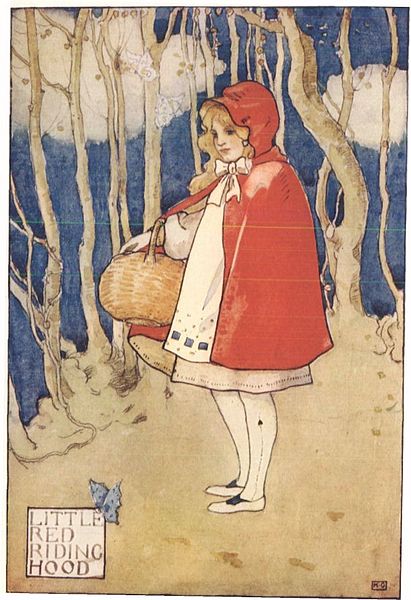
The story revolves around a girl called Little Red Riding Hood, after the red hooded cape/cloak (in Perrault's fairytale) or simple cap (in the Grimms' version called Little Red-Cap) she wears. The girl walks through the woods to deliver food to her sickly grandmother (grape juice and banana bread, or wine and cake depending on the translation). In the Grimms' version at least, she had the order from her mother to stay strictly on the path.


A mean wolf wants to eat the girl and the food in the basket. He secretly stalks her behind trees and bushes and shrubs and patches of little grass and patches of tall grass. He approaches Little Red Riding Hood and she naïvely tells him where she is going. He suggests the girl pick some flowers, which she does. In the meantime, he goes to the grandmother's house and gains entry by pretending to be the girl. He swallows the grandmother whole (in some stories, he locks her in the closet) and waits for the girl, disguised as the grandma.


When the girl arrives, she notices that her grandmother looks very strange. Little Red then says, "What a deep voice you have!" ("The better to greet you with"), "Goodness, what big eyes you have!" ("The better to see you with"), "And what big hands you have!" ("The better to hug/grab you with"), and lastly, "What a big mouth you have" ("The better to eat you with!"), at which point the wolf jumps out of bed, and swallows her up too. Then he falls asleep.


A lumberjack (with the Brothers Grimm, and always in German tradition, a hunter), however, comes to the rescue and with his axe cuts open the wolf, who had fallen asleep. Little Red Riding Hood and her grandmother emerge unharmed. They fill the wolf's body with heavy stones. The wolf awakens and tries to flee, but the stones cause him to collapse and die. (Sanitized versions of the story have the grandmother shut in the closet instead of eaten, and some have Little Red Riding Hood saved by the lumberjack as the wolf advances on her, rather than after she is eaten.)[4]


  • Carmen (her mother)-The Grandmother
  • Mercedes-Hunter/Lumberjack
  • Captain Vidal-The big bad wolf
  • Ofelia-Little Red 


Friday, November 15, 2013

Response to Water

The film follows Chuyia, one of the many widows of India as she tries to figure out what it means to be a widow. As a young child she was already married off to older man who by the time the film begins is dying. Not a moment was wasted before her head was shaved, was given a white Sari and sent to live with other widows. She constantly questions the laws set out for the widows of India and has trouble conforming to them. Especially why widows have to live a life of purity and perpetual mourning for the husband they have lost.


Chuyia believes that her stay with the widows is only temporary so she acts like it is.  More importantly, she acts her age when it comes to handling situations that beyond her control.  She runs, screams, fights, and hurts people who hurt her. Shakuntala who follows every law of the widow and seeks religious counseling often becomes a maternal figure for Chuyia.  Everything Shakuntala did was to fulfill her obligation to her religion until she heard the laws where changing. She then knew that Chuiya’s life could be better so decides to give her to Narayan to make sure Chuyia gets to Gandhi, someone promised to change things for widows in India. 

Saturday, November 2, 2013

Interesting use of music in Nicolas Winding Refn's Drive


What makes this use of music so amazing is  in this scene is how "Under Your Spell" by Desire can be heard first as a diegetic sound coming through the walls while we are in Driver's apartment. Then we hear it full blast in Irene's apartment again as a diegetic sound until her husband Standard mentions how much he appreciates how she stood by him while he was in jail. Yet during this time Irene met and fell in love with Driver and you see that expressed with the close up on Driver and Irene  in their apartments respectively  while "Under My Spell" is clearly non-diegetic. The song then goes back to a diegetic song when Driver is leaving his apartment. I just think it is absolutely brilliant the way the Winding Refn used this song how two characters who rarely speak feel about each as well as using it in a way that is clever and feels grounded in reality.